What can playfully be described as a kerfuffle around how DSP IDs are being derived in the bidstream, the recent discord at the IAB Tech Lab has exposed not only shortcomings in the RTB protocol, but also a functional deficit in the programmatic ecosystem.
At the heart of the debate is the issue of how some SSPs and publishers are using probabilistic methods to apply DSP user IDs to requests from browsers that do not have 3rd party cookies enabled. Historically, DSP IDs have only been pinned to a cookie. Any bridging of IDs from a cookie-enabled browser to another browser, no matter how reliable the methodology, is not in-line with many DSP expectations. A shorthand term for this activity could be ID-Bridging. Read the rest of this post at Advertising Week.
This entry was originally posted on The Drum as an Open Mic Article.
The exact date upon which the 3rd party cookie vanishes is tough to pin down. What we are reasonably certain of is that sometime in the second half of 2024 the Google team will release a version of Chrome that will have them turned off by default.
One of the foundational underpinnings of online advertising will cease to exist. Falling away will be the common key used to value and target ad opportunities, contextual signals used to build audience segments, attribution functionality used to gauge performance, not to mention the collateral impact that losing all these things will bring.
It’s important to explore both the direct and indirect impact of cookie deprecation to have as much of a complete picture as possible. If one becomes too focused on the direct impact, they will lose sight of the long-term and peripheral damage from the wake of this change.
The Open Web
The most obvious and directly impacted media will be the open web. While contextual advertising is back on the rise, prying cookie-based buying out of the hands of advertisers and agencies is impossible to do without the market forcing the transition.
Relying solely on cookied users up until the last minute is a game of chicken that will end careers. Those marketers unwilling or unable to adapt ahead of time may find themselves playing catch-up while their counterparts are thriving.
Cookies gave marketers a level of certainty that they were targeting the exact person or device that was appropriate for the campaign. Retargeting benefited greatly from this functionality once it was combined with the ubiquity of header bidding, RTB and programmatic stacks. Reaching the person who left the store after “just looking” frequently brought them back to buy the thing they were looking at.
Several agencies went so far as to acquire data companies. These acquisitions could easily turn to write-offs without intelligent, targeted investment in wholly new paradigms of finding and building audiences.
Walled Gardens
Many see the walled gardens as fairly insulated from the loss of cookies. It’s not true. The immediate impact that Apple’s ATT had on Facebook should be proof of that. Without an ability to read an ID in a 3rd party context, walled gardens lose much of their ability to extend their media buys across other properties or even show attribution metrics.
In these murky times, it’s unclear as to whether or not the open web will benefit by receiving more direct buys from advertisers, or if the advertisers will just double-down on the O&O of the walled gardens. It’s the same audience they were reaching before, but the deterministic signals are mostly stuck inside the walls now.
Audience
Without a cookie, data companies cannot pin behaviors to a user. They cannot build a deterministic profile. Everything online, absent something like hashed emails, which are scarce, becomes probabilistic, and temporally unstable.
It’s not as though other IDs or designators don’t exist in different contexts, that’s a given. The problem is that the open web offers a richness of context unmatched by any other segment of media. Without that context and a reasonably stable identifier, audience segment diversity dwindles. With the web: auto enthusiast, charitable, camping, and a hundred other interests can be derived from browsing activity. Without the web: a dozen well-used apps, a few regularly watched TV shows, sports.
Bleeding Over
When the audience signals fade, the impact spreads far beyond the web. CTV, mobile, even Digital Out of Home targeting leverages the contextual segmentation from online, web activity. Identity graphs may do well to continue linking devices together, and create household profiles. That doesn’t help fill in the audience signal gap that sits behind the graph in the segment targeting of a campaign.
It’s not just the targeting, but the post campaign analysis that may suffer. With fewer signals, the audience becomes more difficult to discern. Understanding which group converts, where to target the follow-up, finding opportunities, all these things become, if not more difficult, less reliable.
Light in the Darkness
Some believe there’s yet one more reprieve from the 3rd party cookie’s impending demise. The chance of it living beyond 2024 is shrinking, not growing. All recent indications coming out of the Chrome camp suggest that they’re going to stick to their commitment to deprecation in 2024
The industry has been preparing for the loss of signal for several years now, thanks in part to Google moving the deadline. It was a good wake-up call. Solving the online advertising problems that arise from a lack of cookies, however, takes time. Thankfully, we’ve had just that, even if we aren’t likely to get any more.
Several tools are out there. Most are currently in a foundational stage, alpha and beta testing, and being applied in practice to browsers that are already cookie-cripled. Hashed emails (HEMs), 3rd party IDs, 1st party IDs, browser fingerprints, and IP addresses are just a few identifiers in play. Not all are as privacy friendly as some of the platforms and privacy advocates would like, and others might not be as popular (yet) with all industry players.
Even with these alternatives, buyers and sellers must still fundamentally shift the way they do business. None of these solutions offer the same level of coverage on user activity as the cookie does, even with only the one, mostly-dominant browser still supporting them. And some of these solutions will be threatened by the same forces that are pushing the cookie out.
Ad tech has been–and still is–in the process of hedging their bets, partnering with multiple solution providers, augmenting systems to recognize and leverage some of these alternative methods of identity, and talking about new ways of doing business that are more privacy friendly. Don’t be caught flat-footed. There’s work still to be done by everyone. But that’s why we all got into this business, right? There’s always another challenge around the corner.
Last October Yieldmo hosted a client summit in Park City, Utah. I was fortunate enough to kick off the first day with a trip down memory lane… privacy memory lane. Often I find myself acting as Internet historian since I’ve been enamored with the thing since the late 80s, logging on to the local BBS and playing Trade Wars 2002 late into the night.
At the summit I traced back online advertising’s rise to the creation of the humble cookie in 1994. It was a seminal moment for the web as it allowed a browser to maintain state between web pages. I rambled on through a series of events, highlighting each milestone’s impact on advertising as well as noting the privacy implications. As the years went by, society at large took notice of the wealth of information being distributed across the globe and eventually cried out loud enough to force governments and large companies to address their concerns.
I documented swings between discrete tracking and privacy safeguards in a post on The Drum called The Privacy Pendulum. I’m finally posting the unabridged text here, enjoy.
The Humble Cookie
The year was 1994. I was a student at the Illinois Institute of Technology and had switched majors to Computer Science. The Internet, with a capital I, had me in its grasp. I was enamored with all things web. Looking back I think I must have been easily impressed, because gray backgrounds with blue and black text don’t seem all that impressive today. The promise of the web was readily apparent, though. It just needed a few more features to really take off.
1994 was also the year Lou Montulli, a Netscape engineer, invented the cookie. He wasn’t trying to open the door to an industry to revolve around audience tracking and targeting. He just wanted a shopping cart to work properly on the web.
I sat down (virtually) with Neera Shanker from Blockthrough in December. We discussed a few market trends like non-addressable audiences, privacy regulation and the platform giants (Apple and Google).
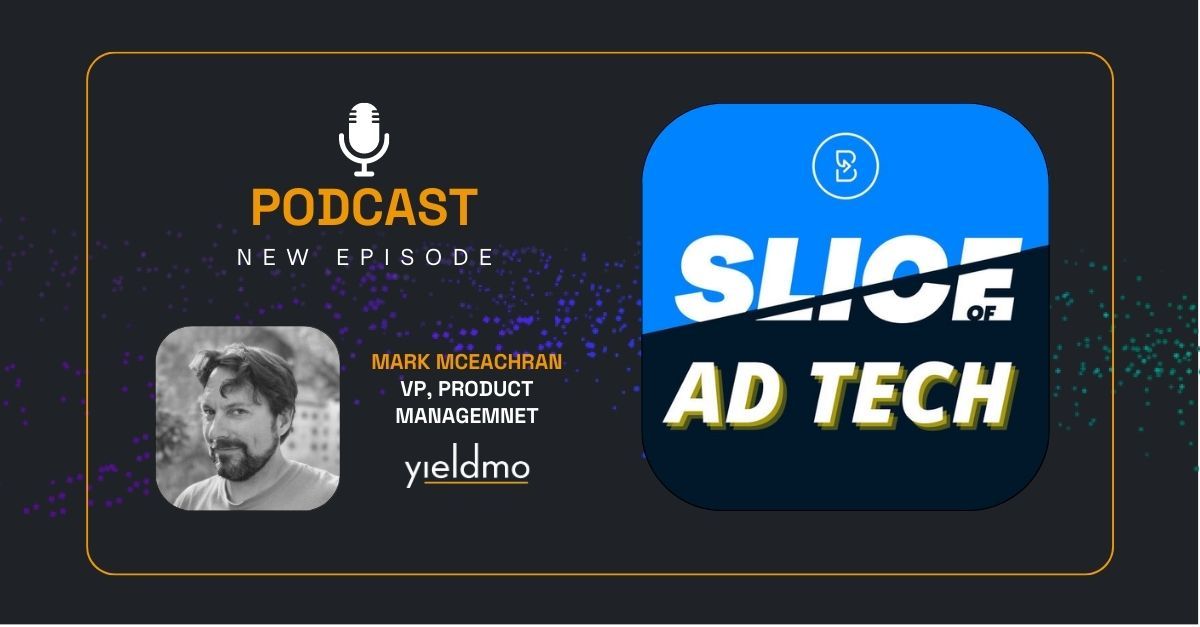
In this episode, I actually know wtf I’m talking about. It’s only my second attempt at guesting on a podcast. And the first time I really had the appropriate expertise on a subject.
Here I’m talking about ad-tech and how non-addressable audiences (no cookie IDs and such) are an important area of focus. Many online publishers are not giving this topic enough attention. If that kinda thing is interesting to you, or you just like hearing the sound of my voice, give it a listen.
Tune in to learn about how I got started in ad tech waaaaaay back in 1997. The internet was a different place back then. It’s striking to remember how a small operation could have a large impact.
Then you’ll hear about my work at Yieldmo, my day job. Hint: I really like my job. In my best radio voice I talk about my typical day, challenges I’m helping to overcome, and how we measure success.
Finally, I evangelize the need for non-addressable solutions in the market. It’s a big issue that will require investment (time and money) in order to future-proof the industry.
If you’d like to grab the podcast in your favorite app, jump over to buzzsprout for the links.
You may have heard of this being referred to as Stack Class. These white-board sessions originated in the early days of Real-Time Bidding (RTB), before the dark times… before The Empire, er.. Header Bidding. Before Header Bidding.
This video is a little dated, but it covers the technical basics of RTB. I’ve been toting it around for years privately. I figured it’s about time to set it free.
I called it Stack Class in the beginning because I was describing all the components of Real-Time Bidding, you know… the stack upon which everything is built. In this video you’ll find SSPs, DSPs, user synchronization (cookies?!%$#@!), bids, responses, PMPs, ad markup… you know, all the things.